
Risk management
Risk management is integrated in Vesteda’s strategic and operational processes. We have defined our risk management policy and implemented a risk management framework in line with the core fund risk profile, as defined in the Vesteda Residential Fund’s Terms and Conditions, extending to all levels of the organisation and all lines of business.
Vesteda has developed its internal risk management framework on the basis of the recommendations of the Committee of Sponsoring Organisations of the Treadway Commission (COSO), the aim of which is to create a reasonable level of assurance on the achievement of organisational targets. Vesteda’s internal control systems include various measures for achieving adequate segregation of duties, prompt recording of significant transactions and data security. Internal accountability and management reports, management reviews and other internal research into the design and operation of the company's internal controls are an integral part of the internal control systems.
Vesteda also uses the ‘Three lines model’ to manage risks (first line: Management; second line: Business control, Risk committee and Compliance; third line: Internal Audit). This model enhances the awareness of the risk culture within Vesteda and underlines and supports accountability for the management of risks and internal controls.
The three lines model emphasises that focus should be on the contribution risk management makes to achieving (strategic) objectives and creating value, as well as to matters of ‘defence’ and the protection of value. Vesteda also supports the principles to the effect that:
-
There must be regular interaction between Internal Audit and management to ensure the work of Internal Audit is relevant and aligned with the strategic and operational needs of the organisation;
-
There is a need for collaboration and communication across both the first and second line roles of management and Internal Audit to ensure there is no unnecessary duplication, overlap, or gaps.
Vesteda’s Internal Audit department provides assurance and advice on the adequacy and effectiveness of governance and risk management (including internal controls) to support the achievement of organisational objectives and to promote and facilitate continuous improvement.
Risk appetite
The INREV core fund risk profile implies that Vesteda has a relatively low-risk profile since it typically invests in income-producing real estate investments. Vesteda employs relatively low levels of leverage and has limited exposure to real estate development. A significant and stable proportion of its returns are generated through rental income. Overall, Vesteda has a relatively low risk appetite. Please see Note 27 to the consolidated financial statements for a description of our financial risk management objectives and policies.
Risk Committee
Vesteda’s risk management activities were supported by the Risk Committee during the first part of 2025. The Committee had a defined mandate focused on operational and compliance risk management. Its tasks included advising the Management Board and Management Team on the periodic identification, assessment and mitigation of operational risks; establishing policy frameworks for operational risk management; providing methods and tools to line management; monitoring key operational and compliance risks and the effectiveness of related controls; promoting risk awareness within the organisation; and providing insight into Vesteda’s overall risk profile. The Committee did not identify or monitor strategic risks. Strategic risks, which relate to Vesteda’s long‑term objectives as set out in the Business Plan, were the responsibility of the Management Board and Management Team. Any potential strategic impact identified by the Committee was reported to the Management Board.
The Risk Committee was chaired by the CFO and further comprised the COO, the General Counsel, the Control Manager, the Digital & Innovation Manager and the Compliance Officer. The Internal Audit Manager attended meetings but was not a member. The Committee’s roles, responsibilities and reporting lines were defined in the Risk Charter. The Risk Management Policy, last updated in 2022, formed the basis for its activities.
During the reporting year, the Risk Committee met once. The agenda for this meeting included DNB prudential supervision, the Treasury report for the fourth quarter of 2024 and an update on the implementation of DORA.
In the course of 2025, Vesteda reassessed the role and positioning of the Risk Committee in response to developments in the organisation’s risk management framework. The implementation of DORA strengthened IT risk management, and compliance and privacy risk management were further developed. As these elements became more firmly embedded within the line organisation, the need for a separate Risk Committee in its existing form diminished. Vesteda therefore initiated a transition towards a more integrated risk management model. Strategic risks are now discussed directly within the Managing Board and are shared with the Supervisory Committee to ensure continued oversight at the highest governance level. The review of treasury‑related risk reports has also been transferred from the Risk Committee to the Managing Board. An initial assessment of the future role of the Risk Committee was conducted in 2025 and will be further developed in 2026. These changes reflect Vesteda’s commitment to maintaining an effective and integrated risk governance framework in line with regulatory developments and the evolving risk context.
The scope of risk management
Vesteda distinguishes the following three main risk areas:
1. Risks related to strategic targets as defined in the Business Plan
This relates to specific risks regarding tenants, the portfolio, participants (equity funding), the organisation and debt funding.
The Management Board and the Management Team primarily focus on:
-
Identifying and assessing the Strategic Risks annually on the basis of the most recent Business Plan;
-
Monitoring the Strategic Risks and the effectiveness of the associated control measures on a quarterly basis;
-
Adjusting the control measures with regard to the Strategic Risks if these are not considered sufficient.
The Management Board reports to the Supervisory Committee on the strategic risks and measures on a quarterly basis.
2. Operational risks related to the failure of systems and processes
Operational risk management is part of Vesteda’s business processes and is governed by specific guidelines, policies and key controls designed to manage these operational risks, which are subject to internal reviews and external audits where appropriate.
Each year, Vesteda’s external auditor provides assurance with respect to the design and effective operation of controls based on the International Standards on Assurance Engagements (ISAE), Standard 3402, type II. Vesteda selects the relevant controls to be audited and concluded upon in the assurance report, and these relate to key controls within the most important business processes, primarily Acquisitions, Property and Portfolio Sales and Operations.
3. Compliance risks related to non-compliance with legislation and (internal) regulations
Vesteda defines compliance risk as the risk of financial loss, reputational damage or operational disruption resulting from non-compliance with laws, regulations, internal policies or ethical standards. Managing this risk is essential to safeguarding trust and ensuring responsible business conduct.
Compliance and integrity form the foundation of Vesteda’s license to operate. We go beyond legal requirements by embedding integrity in daily operations and decision-making and expect the same from our business partners.
Compliance is part of Vesteda’s governance framework, reporting to the CFO and Supervisory Committee. The function provides policies, monitors risks, advises on regulatory developments, and supports training and awareness. Acting as a strategic partner, Compliance helps integrate integrity and regulatory compliance into processes and decisions.
Key compliance risk areas include anti-money laundering and sanctions, privacy and data protection (including ethical AI use), fraud, bribery and corruption, ethical conduct, outsourcing, and competition law. Misconduct can be reported via SpeakUp or directly to Compliance and is investigated jointly with Internal Audit.
Fraud prevention and integrity safeguards are assessed annually through the Systematic Compliance Risk Analysis and ISAE 3402 Type II reviews. In 2025, Vesteda strengthened internal controls, investigated potential fraud cases, and used findings to improve processes. We also implemented measures to embed compliance and privacy risk management more deeply in our governance and operations.
4. IT risk
In 2025, Vesteda implemented an IT control framework to ensure compliance with the Digital Operational Resilience Act (DORA). This framework is embedded in our risk management approach and strengthens our ability to manage IT risks and safeguard the continuity of critical processes. It incorporates robust incident management, regular resilience testing, and stringent oversight of third-party IT providers. By integrating digital resilience into our governance structure, Vesteda positions itself as a future-ready organisation that meets European standards and proactively addresses technological and operational risks.
5. Tax risk
In December 2022, Vesteda signed a covenant (‘Convenant Horizontaal Toezicht’) with the Dutch Tax Authorities for a period of three years. As part of the covenant requirements, Vesteda performed a tax risk analysis and implemented a process to monitor, audit and review the operational effectiveness of the system of internal controls to cover the tax risks and to ensure correct tax returns. The findings of this process confirmed that the design and operation of these controls provide a sufficient basis to ensure correct tax returns. In 2024, Vesteda set up a Tax Committee to oversee the compliance with the covenant and to monitor the continuing quality and effectiveness of the tax controls. At the end of 2025, the Tax Authorities confirmed the good progress made by Vesteda and as a result both parties signed an extension of the covenant for another three years (2026 – 2028).
Strategic risk analysis
Vesteda’s strategic risk analysis is based on the following assessment, which is executed by the Management Board and Management Team jointly:
-
Identification of strategic risks, based on the strategic targets and key performance indicators within the three strategic pillars: economic value, social value and organisation. These strategic targets and risks are based on the five-year Business Plan, as approved by Vesteda’s Participants each year in December, along with actual developments;
-
An assessment of the level of risk Vesteda is willing to accept in achieving its strategic targets (risk aversion) to provide guidance for decisions related to risk and return management. The outcome of this assessment also serves as a basis for the review of the effectiveness of the nature and level of internal controls for each risk. The level of risk aversion is measured based on a scale of 1 to 5: Risk averse, Limited risk, Cautious, Flexible and Open.
In alignment with the key characteristics of Vesteda as a Core INREV fund, with a conservative funding policy focused soley on residential real estate in the Netherlands, limited risks or a cautious approach is necessary if Vesteda is to meet it's strategic targets (risk aversion of mostly 2, partly 2-3):
-
Classification of identified risks based on impact (high – low) and to what extent the risk is manageable (ranging from largely manageable – not manageable);
-
Defining the internal controls (implemented or to be implemented) for each of the identified risks, the required level of effectiveness for these controls and the relevant key performance indicators to monitor effectiveness.
The outcome of this review is depicted in the Vesteda Risk Profile figure.
The monitoring of the following strategic risks and the effectiveness of internal controls, as well as the identification of new strategic risks is the responsibility of the Management Board and the Management Team and will be discussed at least quarterly in 2026.
Vesteda Risk Profile
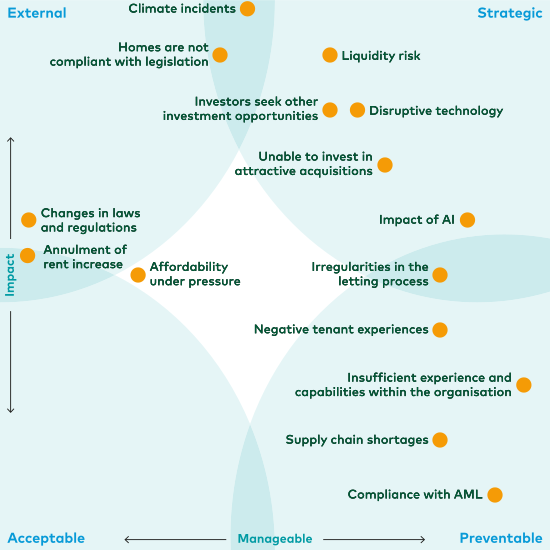
For each of the risks shown in the Vesteda Risk Profile above, the main internal controls are:
External risks, potential high impact, no or limited controls on risk occurring
Risk: New legislation for the sector on rental processes, fiscal matters, construction & development, climate and sustainability
Changes in laws and regulatory requirements related to rent (increases), investments (local requirements or product-specific requirements, e.g. regulated mid-rental segment), building requirements (sustainability), fiscal laws impacting investments in real estate, etc.
Internal controls
As changes in legal and regulatory requirements are beyond Vesteda’s direct control, the main focus in addressing this risk is on identifying and discussing possible changes and alerting and preparing the organisation. This is realised through our multiple contacts with the sector association IVBN and contacts with city councils, politicians, developers, etc. Where relevant, we take the effect of potential changes in laws and regulatory requirements into account in our business planning, including impact analyses and stress testing, where relevant.
With respect to the risk related to rental regulation, we are taking an active role in the affordability debate, together with the IVBN. We believe it is important to behave as a socially responsible investor and to highlight the role we have in responsibly investing pension savings and insurance premiums entrusted to us by our participants in residential real estate for middle-income tenants.
We execute stress tests to calculate the impact of (potential) new regulatory requirements on Vesteda’s portfolio, and rental income and we make sure that we have continuous insight into the entire portfolio to anticipate changes in legislation. In 2024, we started to scan and remeasure the entire portfolio, including determining the WWS points for each unit and we completed this scan in the first half of 2025.
In addition, Vesteda closely follows the legislative developments on sustainability closely to stay abreast of (reporting) requirements. We started preparing for the implementation of the CSRD in 2024 and continued this work in 2025, applying certain elements on a voluntary basis. Please see the Sustainability Statement for more information on the scope of the CSRD.
Vesteda also executes a periodic review of its technical standards for new-build homes. In addition, Vesteda closely monitored the outcome of court verdicts on rent increase clauses, the verdict of the Dutch Supreme Court on the prejudicial questions submitted to it and the potential impact on Vesteda.
Risk: Homes are not compliant with legislation
Our homes cannot meet all requirements set by (EU) legislation with respect to climate mitigation and sustainability.
Internal controls
Vesteda has implemented a number of internal controls for this specific risk, the most important of which are:
An investment programme to improve the energy labels of our homes. Please see the Environmental section of this report.
Vesteda has a ‘Policy on the integration of sustainability risks and factors into the investment decision-making process’, which provides insight into which potential sustainability risks Vesteda has identified and how these risks and principal adverse impacts on sustainability factors are integrated in investment decisions related to new acquisitions or renovation projects.
Sustainability and climate risks form an important part of Vesteda’s investment decision process for new acquisitions and renovation projects. Vesteda applies its technical standards to assess whether new (potential) investments comply with Vesteda’s sustainability and technical requirements (which focus on climate change mitigation and adaptation) and reviews these technical standards on a periodic basis to ensure they still comply with applicable legislation. Vesteda uses an ESG framework to determine a sustainability impact score for each project to provide a broader view of relevant sustainability risks and factors and to ensure new projects meet the applicable ESG requirements to qualify as sustainable. This score was updated in 2025 to reflect new insights and developments.
Please see the Environmental and Acquisitions and property sales sections of this report.
Risk: Climate incidents
Incidents related to extreme weather conditions/climate change affecting our portfolio, such as flooding, heat stress, earthquakes, etc.
Internal controls
This is also a risk that is largely beyond Vesteda’s direct control. However, in terms of mitigating the impact of climate incidents, Vesteda has taken the following measures:
A climate risk scan for the entire portfolio. Based on this scan, we devote specific attention to the risks of heat stress and flooding in our long-term maintenance programme per residential complex. Climate risks are also a recurring topic when reviewing our insurance programme. Please see the Physical climate risks section in the Environmental section of this report.
Furthermore, we assess our insurance programme on an annual basis and take this topic into account.
Risk: Affordability under pressure
Affordability of housing is under pressure due to scarcity, energy costs and inflation.
Internal controls
Vesteda is taking several measures to manage and improve the affordability of housing. We invest in the sustainability of our assets and inform tenants about energy-saving possibilities, to lower energy costs. We also focus our new investments in new-build projects on the (regulated) mid-rental segment, to add affordable homes to the housing market. Furthermore, by executing a thorough income check prior to entering into a rental agreement and monitoring our tenants’ payment behaviour, we can take action, for example by offering more affordable housing to tenants in financial difficulty. We also inform our tenants on how to reduce their own energy consumption and energy costs.
Risk: Annulment of rent increase clauses
In 2023, several Dutch district courts held that certain rent review clauses consisting of CPI plus a surcharge could be considered unfair, creating a risk that historical rent increases might be invalidated and subject to repayment. At the end of 2024, the Supreme Court provided clarification, ruling that a surcharge on top of CPI is not in itself unlawful. The indexation component and the surcharge must be assessed separately, given their different purposes. The Supreme Court also indicated that a surcharge of up to approximately 3% above CPI is generally not considered unfair.
At the end of 2025, the Amsterdam District Court announced its intention to submit preliminary questions to the European Court of Justice in a case involving a CPI +7% clause linked to the development of the value of immovable property (WOZ value). Depending on the scope of those questions, this may have implications for a broader range of surcharge clauses. In legal proceedings initiated by one of Vesteda’s tenants, the Amsterdam Subdistrict Court ruled that the +4% surcharge included in the tenant’s lease agreement should be considered unfair, while the CPI indexation component itself remained valid. Vesteda has appealed this decision. At the end of 2025 and early 2026, the Amsterdam Court of Appeal issued two judgments in which a +5% surcharge was similarly found to be unfair.
Internal controls
This risk remains largely outside Vesteda’s direct control. Vesteda contributed to an IVBN interested‑party statement submitted to the Supreme Court and performed high‑level scenario analyses to assess potential outcomes.
Please see Note 32 in the Notes to the consolidated financial statements section of this report.
Strategic risks, potential medium to high impact, reasonable or high level of controls possible on risk occurring
Risk: Investors seek other investment opportunities
Investments in Vesteda (residential real estate) become less attractive for potential new and current investors (primarily as a result of an imbalance between return and risk).
Internal controls
Each year, participants have to approve the Business Plan, which includes the strategy to achieve the targets as set out in the Investment Guidelines of the Terms and Conditions. For example, the outperformance of the three-year MSCI index and a target for the TER. The achievement of the targets is monitored on a monthly, quarterly and annual basis.
During the Business Plan period, management focuses on stable direct returns and increasing distribution yield, providing an inflation hedge for the existing participants and an interesting proposition for potential new investors with a low-risk profile.
Vesteda engaged an advisor to assist in finding new investors in the fund and thus create more liquidity for existing investors.
In 2025, following a sounding process that commenced in 2024 and continued throughout 2025, the Fund’s revised liquidity mechanism was approved by the participants after close consultation with them. In addition, the Management Board continued its preparations for the upcoming liquidity review, which started in February 2026.
Vesteda’s new Business Plan reflects its current impact and ambitions to have a greater impact on society.
We have an active Investor Relations department and have frequent meetings with participants, at which we communicate market developments and the progress of the strategy implementation. In the current market environment, with political discussions on affordability and the impact of rent increases, we believe it is important to discuss Vesteda’s strategy as a socially responsible investor, especially when this pertains to decisions regarding tenant satisfaction, rent increases and sustainability.
Risk: Redemptions by investors may prevent Vesteda from making new investments or to deleverage or could lead to the sale of assets or an increase in leverage (Liquidity risk)
Once every seven years, the Fund is subject to a ‘liquidity review’ by the participants of the Fund, which started in February 2026, please see Note 34 for more information. The liquidity review triggers the mechanism by which participants are given the opportunity to re-evaluate their respective Participation Rights in the Fund and to indicate if and to what extent they would like to redeem all or a portion of their Participation Rights or increase the number of their Participation Rights. In general, if participants want to redeem all or a portion of their commitments this may lead to a redemption queue.
Internal controls
If less than 10% of the participants decide that they would like to have all their Participation Rights redeemed, the Fund could use the yearly Redemption Available Cash amount to redeem Participation Rights and/or attract new financing, attract new participants or sell assets. If more than 10% of the participants decide that they would like to have all Participation Rights redeemed, Vesteda must draw up a liquidity plan. In 2025, the yearly Redemption Available Cash amount was €50 million. The Annual General Meeting held on 3 December 2025 approved an increase of this amount to €150 million as from 2026. In addition, the Manager may use proceeds from property sales to further increase the amount available for redemptions.
Vesteda has an active investor relations programme to attract new investors enabling participants to redeem their participations well ahead of the liquidity review date.
Risk: Disruptive technology
Vesteda’s business model is disrupted by new innovative technology.
Internal controls
Digital technology provides the residential investment industry (and adjacent sectors) in general and Vesteda specifically with new resources to create and capture value for all stakeholders. This may, for example, mean that a residential property also functions as a platform for the sale of additional goods and services to its users, thereby increasing the tenant’s perception of value and willingness to pay for it. As a result, boundaries between sectors may blur and young, agile and cost-efficient companies may become competitors for existing players in the relatively traditional housing market. Digital technology may also be a source of optimised rental income streams and structural savings in general, or operational and capital expenditures, while at the same time improving sustainability, tenant satisfaction and the risk profile of the investment.
Exploiting the full potential of digital technology requires a deep understanding of the opportunities and risks associated with it and requires a holistic vision on digital technology as a key resource for strategy definition and execution. Vesteda is already applying digital technology in several parts of its business model and processes and is increasingly working on incorporating digital technology in strategy definition and organisational design. Failure to keep up with these developments may have a negative impact on Vesteda’s competitive position in the longer term, as well as access to new investment products. Vesteda mitigates this risk today by recognising both the opportunities and the risks of digital technology and improving its business model and organisation in phases using digital technology, which is reflected in Vesteda’s ambition to become a digital powerhouse, as set out in its Business Plan.
Risk: Inadequate governance and control over the use of Artificial Intelligence (AI)
Vesteda may face strategic, operational, ethical and compliance related consequences if AI is applied without sufficient governance, oversight and controls. This could lead to inaccurate or biased outcomes, data privacy issues, reputational harm or decisions being taken without adequate human validation. As AI becomes more integrated into Vesteda’s business processes, ensuring reliable, transparent and responsible use is increasingly essential.
Internal controls
Vesteda is strengthening its governance and control framework for AI to ensure responsible, secure and compliant application of these technologies. This includes developing a clear policy framework, introducing a risk‑based assessment and approval process for new AI use cases, and defining roles and responsibilities to ensure appropriate human oversight of AI‑supported decisions. Existing AI initiatives have already been reviewed against relevant legal and regulatory requirements. Vesteda is also enhancing measures to safeguard data quality, privacy and security, and setting up monitoring procedures to detect unintended outcomes or system deviations. Employees have received initial training on responsible AI use, and additional, more advanced training modules are currently being developed. Finally, Vesteda is further improving transparency and documentation to ensure that the functioning and limitations of AI tools are traceable and explainable for internal and external stakeholders.
Risk: Unable to invest in attractive acquisitions
Vesteda is unable to invest in new acquisition projects to strengthen the portfolio due to lack of success in acquisition processes and/or reduced appetite to invest as a result of fund and/or market circumstances.
Internal controls
Dutch residential investments are seen as a safe haven with an attractive risk/return profile, due to the scarcity in supply and high demand. Vesteda is active throughout the value chain: Vesteda is proactively interacting with developers, contractors and local authorities using our in-depth knowledge of local markets and developments and positioning itself as a solid long-term partner. We are temporary scaling-back in terms of acquisition volumes, to reduce our funding needs as part of the liquidity review event in February 2026, please see Note 34 for more information. However, we aim to stay in the market, since a modest but constant inflow level increases the quality of our portfolio. We will continue long-term business partnerships, so we can benefit from potential market opportunities in the future. In addition, we will continue to focus on optimising value creation in our standing portfolio.
As part of our acquisition policy, we have also implemented a range of internal controls, including:
-
Monitoring of acquisition leads funnel and the conversion of leads;
-
Annual evaluation of IRR requirements;
-
Optimising value creation in the standing portfolio.
Preventable risks, medium to low impact, high level of controls possible on risk occurring
Risk: Negative tenant experiences
Vesteda’s image and reputation is affected by collective/individual negative tenant experiences, which may result in low(er) tenant satisfaction scores.
Internal controls
Tenant satisfaction is one of Vesteda’s major key performance indicators and this is therefore monitored on a continuous basis. Tenant satisfaction surveys are sent out after repairs, termination of the rental contract, etc. Tenant satisfaction is included in the annual targets for the Management Team, senior management, departments and employees. Please see the Social section of this report.
In the event of tenant complaints, Vesteda strives to act and communicate quickly and transparently. Vesteda makes sure that cases are evaluated and that lessons learned are shared internally in order to improve processes in the future.
Risk: Irregularities in the letting process
Vesteda’s image and reputation is affected by irregularities in the letting process.
Internal controls
Vesteda has a customer due diligence procedure in place to comply with anti-money laundering legislation related to tenants, among other things. Vesteda provides employees who are in charge of screening tenants with additional training and reference materials.
Vesteda is working on the further digitalisation of the letting process, in order to ensure a more uniform applicability of the set selection criteria.
The Compliance department provides support to the Operations department in the letting process and the assessment of new tenants. In addition, Vesteda organises in-house workshops on client due diligence. Vesteda has opened up its SpeakUp line to external parties, including tenants. It has also investigated cases of suspected fraud and, when deemed appropriate, reported these to the police.
Risk: Retention, engagement and performance of employees
The risk that Vesteda cannot attract and retain the right talent to achieve its ambitions and the risk that Vesteda’s employees are less engaged and show a lack of performance.
Internal controls
Vesteda has a professional HR department in charge of attracting and retaining highly qualified staff, through recruitment procedures, talent management and training programmes. Please see the Social section of this report.
Vesteda aims to become a High Performance Organisation and focuses continuously on actions and milestones to achieve this goal. In order to monitor Vesteda’s status, we conduct a bi-annual survey among our employees. The results of the latest HPO and employee engagement surveys show that our employees are increasingly positive on our organisation and feel connected to the company, even though many employees continue to work from home part of the time.
Please see the Social section of this report.
Risk: Supply chain shortages
Materials and tooling are not available or extremely high priced, leading to possible delays in the start/execution of investments and maintenance.
Internal controls
Vesteda continuously assesses projects for which this could be an issue and has looked into the possibilities of delaying projects or providing additional budget.
Risk: AML & Sanctions‑risk
The risk that Vesteda enters into agreements with parties whose identity, ownership structure or activities present money‑laundering risks, or that Vesteda engages with suppliers, tenants or other counterparties that are linked to sanctioned countries, entities or individuals.
Internal controls
Vesteda performs a UBO check on Commercial Real Estate transactions and reviews the ownership structures of relevant parties. Vesteda also assesses whether key suppliers operate in or depend on countries on sanction lists, with specific attention to framework agreements. Homes rented to companies are subject to additional verification, and all new suppliers are screened against applicable sanction lists. In addition, Vesteda investigated options in 2025 to reduce manual handling in AML & Sanctions processes to further improve consistency and efficiency.
‘In control’ statement
The Management Board is responsible for implementing and maintaining adequate risk management and internal control systems and for assessing the effectiveness of these systems.
In the year under review, we evaluated and monitored our risk management and internal control systems, as further described in the above Risk management section of this report. Based on this assessment, we concluded with reasonable, but not absolute, assurance that:
-
The annual report provides sufficient insights into any failings in the effectiveness of the internal risk management and control systems;
-
The aforementioned systems provide reasonable assurance that the financial reporting does not contain any material inaccuracies;
-
Based on the current state of affairs, it is justified that the financial reporting is prepared on a going concern basis;
-
The annual report states those material risks and uncertainties that are relevant to the expectation of Vesteda’s continuity for the period of twelve months after the preparation of the report.
It is important to note that effective risk management, with embedded internal controls, no matter how well designed and implemented, provides the Management Board with only reasonable assurance regarding the achievement of Vesteda’s objectives. The achievement of objectives is affected by limitations inherent in all management processes. Therefore, in this context ‘reasonable assurance’ refers to the degree of certainty that would be satisfactory for a prudent manager in the management of their business and affairs in the given circumstances.