
General Information
BP-1 - General basis for preparation
Vesteda’s approach to sustainability reporting
Over the past few years, Vesteda has taken a leading role in reporting on sustainability topics, including our approach and targets, as we believe that transparency and accountability are essential for moving our ESG ambitions forward. This commitment aligns closely with the disclosure requirements set out in the Corporate Sustainability Reporting Directive (CSRD) and the related European Sustainability Reporting Standards (ESRS).
In 2025, the European Parliament approved the Omnibus I package proposed by the European Commission, which seeks to reduce administrative burdens and streamline sustainability reporting requirements. This package includes proposals to narrow the scope of the CSRD and simplify the European Sustainability Reporting Standards (ESRS). Vesteda may be affected by these proposed changes. However, given that the revised criteria have not been fully formalised, nor transposed into national legislation, it cannot yet be concluded with certainty that we fall outside the mandatory reporting scope. We therefore continue to closely monitor the regulatory process.
Despite the current uncertainty, we recognise the strategic importance of transparent sustainability reporting. Initially, only Vesteda Finance B.V. qualified as a reporting entity under the CSRD. In response to the initial obligation, Vesteda made an internal decision to voluntarily extend CSRD-aligned reporting to the Fund level in our consolidated annual report. This decision was driven by Vesteda’s ambition to integrate sustainability information into its reporting in a reliable manner and the accountability that comes with that. This ambition is reflected in our mission Housing as a Force for Good. Through this mission, we aim to create sustainable and liveable environments that enhance the well-being of our tenants and communities.
As such, Vesteda strives to make the reporting in its consolidated annual report as comprehensive as possible in line with the CSRD requirements, using its framework as our guiding reference. This includes all entities of Vesteda Residential Fund, which is the same scope as for the financial statements for the financial year ended 31 December 2025. We believe that complying with CSRD reporting on a consolidated basis gives investors and other stakeholders more comprehensive information regarding the Fund’s sustainability performance and consider this part of our corporate responsibility and commitment to continuous transparency. The basis of preparation of this Sustainability Statement is therefore the same as those for the overall annual report. Vesteda is currently in a transition phase. As a result, certain data sets are not yet available, and some targets have not yet been defined in accordance with ESRS standards. This is partly due to the ongoing development of specific processes and the limited availability of required data points. Where applicable, we ensure transparent disclosure of these limitations.
In accordance with the CSRD and the related ESRS requirements, we have made some changes to the preparation and presentation compared with previous periods, as we changed the format of our reporting on ESG topics. These are now included in this Sustainability Statement to align with the CSRD requirements and are structured in the following order:
-
General disclosures, including basis of preparation, governance, strategy and our approach to double materiality;
-
Environmental disclosures, including our approach to climate change, waste, and our sustainable investment properties;
-
Social disclosures, including those related to the health and well-being of our own people, such as diversity and safety, as well as workers in our value chain;
-
Governance disclosures.
The structure is aligned with the CSRD standards to enable reporting for the 2025 reporting period in accordance with the CSRD requirements. We have added several metrics compared with the previous year to disclose available metrics and targets required under CSRD. Where relevant, these metrics include comparative figures to support meaningful analysis.
With the aim of identifying and determining the scope of the sustainability information pertaining to its value chain and the stakeholders within it, Vesteda has analysed various sources of information throughout its entire value chain. This included factors such as markets and customer segments, main stakeholder groups with which it interacts, as well as the identification of impacts, risks, and opportunities.
As a result of this analysis, Vesteda's value chain has been categorised into three elements or phases:
-
Upstream, which includes suppliers and service providers;
-
Own operations, which primarily comprise employees and Vesteda's own real estate assets; and
-
Downstream, referring to tenants and property management services, focusing on residential customers.
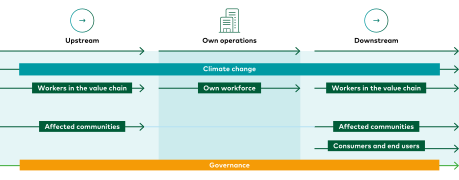
Vesteda assessed this entire value chain in a Double Materiality Assessment (‘DMA’) to identify the material topics as set out in the CSRD framework. This forms the basis of our Sustainability Statement, which is presented in the following figure.
Material topics in Vesteda’s value chain
During the preparation of this Sustainability Statement, Vesteda made no use of the option to omit any applicable specific piece of information corresponding to intellectual property, know-how or the results of innovation (in accordance with ESRS 1, section 7.7.). Moreover, Vesteda does not exclude any of our legal entities from the sustainability reporting scope in the disclosures.
BP-2 - Disclosures in relation to specific circumstances
Time horizons
The reporting period for this Sustainability Statement is the same as the reporting period for the financial statements.
When executing our double materiality assessment, we assess material impacts, risks and opportunities over the short, medium and long term. As sustainability-related matters often materialise over time, this justifies more forward-looking reporting, while financial information is restricted to the annual reporting period.
For the purpose of the Sustainability Statement, we follow the following time frames:
-
Short term: 1 year;
-
Medium term: 1-5 years;
-
Long term: more than 5 years.
Where our horizons deviate from these general principles, this is indicated.
Value chain estimation, sources of estimation and outcome uncertainty
In this Sustainability Statement, we make use of assumptions and estimates in order to determine data points. The most crucial estimates used in this statement are described in this section. Where relevant, we outline the measures taken to enhance accuracy and minimise uncertainty.
With regards to the GHG emissions as included in the section Climate Change, quantitative data are presented, calculated using estimates based on average sector data and other proxies such as emission conversion factors. With regard to energy data, the Fund receives anonymised consumption information from energy and network companies. This data does not cover 100% of the Fund’s residential units in 2025, but only 82.9%. The extrapolation of this data to a full 100% entails that the resulting figures are not derived from fully up-to-date consumption data and therefore inherently involve a degree of estimation and uncertainty. Consequently, the final actual consumption figures - once available - may deviate from the extrapolated values presented herein. Where feasible, the quantitative data in this report is presented alongside comparative data from the previous financial year for context and clarity. Detailed elaboration on the methods and assumptions used can be found in the specific topical disclosures.
With regard to the physical climate risk assessment, there are significant uncertainties regarding the quantification of damage from climate change. Damage relationships are challenging to derive, there are ranges within climate scenarios, and various model choices are possible. In this regard, Vesteda needs to make judgements and estimates that may be critical to the data reported. This includes prospective information, such as ambitions and expectations. For the performance of our physical climate risk assessment, we collaborate with Climate Adaptation Services (CAS). To develop a method for calculating an aggregated risk score for the assets in Vesteda’s property portfolio, CAS utilised the knowledge from the Climate Damage Atlas (Klimaatschadeschatter - KSS) project and scientific literature. Additionally, CAS used data from the national Climate Impact Atlas (Klimaateffectatlas). Further details of this are given in the Climate Change section.
Changes in preparation or presentation of sustainability information versus prior periods
For 2025, there are changes to the preparation and presentation compared with previous periods, as we changed our reporting for the financial year ending 2025 in order to comply with the CSRD requirements. In preparation for this transition, Vesteda already implemented several changes in its 2024 reporting to align with the forthcoming CSRD framework. The content of the 2025 report is aligned with the CSRD standards. As a result, the scope, structure and level of detail of the reported information differ from prior reporting periods.
Vesteda adheres to a sustainability reporting restatement policy that outlines the principles governing restatements and adjustments, including both errors and changes in estimates. Each case of potential restatement or adjustment is evaluated to determine its materiality to the Sustainability Statement, taking into account both qualitative and quantitative aspects. If deemed material, the data from prior periods will be revised unless it is impractical to do so. The rationale behind any revised information will be disclosed alongside the relevant subject matter. No significant restatements have been made in the Sustainability Statement.
In line with the CSRD standards, Vesteda has undertaken a comprehensive review and update of key policy documents that underpin our sustainability strategy. As part of this process, the policies included in this sustainability report have been aligned with the requirements set out in the CSRD, ensuring consistency, transparency, and accountability in our disclosures. The alignment with CSRD standards led to the revision of several core policies, notably Vesteda’s Code of Conduct, Supplier Code of Conduct and Human Rights Policy.
Reporting errors in prior periods
There are no material omissions from, or misstatements in Vesteda’s sustainability reporting for one or more prior periods to be reported.
Disclosures stemming from other legislation or generally accepted sustainability reporting pronouncements
Vesteda is required to provide disclosures under Regulation (EU) 2019/2088 (the EU Sustainable Finance Disclosure Regulation, or SFDR). The Vesteda Residential Fund qualifies as an ‘article 8’ product under the SFDR.
Moreover, the Fund is subject to the Alternative Investment Fund Managers Directive (AIFMD), which classifies Vesteda as a financial undertaking. Consequently, the disclosure requirements with regard to the EU Taxonomy, as referenced in the ESRS standards in the CSRD framework, are considered out of scope and Vesteda has therefore not provided any additional details on these in this sustainability report. This does not imply that the EU Taxonomy requirements are not applicable to Vesteda. In accordance with the EU Sustainable Finance Disclosure Regulation, or SFDR (Regulation (EU) 2019/2088), Vesteda adheres to the EU Taxonomy requirements. For further details, please refer to Annex 2: SFDR disclosures.
In previous years, our sustainability information was reported in line with Global Reporting Initiative (GRI) and Task Force on Climate-related Financial Disclosures (TCFD) standards. However, Vesteda has transitioned to reporting in accordance with the CSRD framework, which incorporates and expands upon the principles of both GRI and TCFD. The CSRD provides a more integrated and detailed approach to sustainability reporting, effectively covering the requirements of the previous standards.
Incorporation by reference
Some ESRS disclosure requirements have already been addressed in other sections of this annual report. Where information is incorporated by reference, this is clearly indicated.
Use of phase-in provisions in accordance with Appendix C of ESRS 1
Vesteda is reporting its sustainability information implementing the requirements of the ESRS requirements. With regards to information prescribed by ESRS E1-9 for quantitative disclosures, we made use of the phase-in possibility for the FY25 Sustainability Statement. Moreover, we omitted the specification of target setting for ESRS S2, ESRS S3 and ESRS S4, in accordance with the applicable provisions. We refer to the following table for further details.
Phase-in provisions
|
Disclosure requirement |
Comment on phase-in |
|
SBM-3 Material impacts, risks and opportunities and their interaction with strategy and business model |
Vesteda omits the information prescribed by ESRS E1-9 for quantitative disclosures, for the first three years of preparation. Vesteda does provide qualitative disclosures of physical climate risks and climate transition risks. |
|
S2-5; S3-5; S4-5 Targets related to managing material negative impacts, advancing positive impacts, and managing material risks and opportunities |
Vesteda omits the specification of target setting for ESRS S2, ESRS S3 and ESRS S4 for the first two years of preparation of the Sustainability Statement. |
For the qualitative disclosure of the anticipated financial effects of climate transition risks, please see section E1-9 Anticipated financial effects from material physical and transition
risks and potential climate-related opportunities.
Governance of sustainability matters
GOV-1 & GOV-2 - The role of the administrative, management and supervisory bodies in relation to sustainability matters
This section sets out the governance processes and controls that are in place to manage and monitor sustainability matters.
Applying good governance benefits all stakeholders, helps to mitigate risks and safeguards Vesteda’s reputation. Governance encompasses multiple aspects, such as: the protection of participants’ rights, board independence and decision-making processes, the regulatory and legal environment, business ethics, executive/equal pay, diversity & inclusion, (personal) data integrity, tax strategy, etc.
Governance has become an important focal point in recent years, as European legislation related to ESG reporting has amped up. For example, the Sustainable Finance Disclosure Regulation requires financial institutions like Vesteda to be transparent about the integration of ESG factors in their business models and to report the extent to which their portfolios are EU Taxonomy aligned. Certain minimum safeguards, such as compliance with the OECD guidelines for multinational enterprises and the UN Guiding Principles on Business and Human Rights, which include the principles and rights set out in the International Labour Organisation’s Declaration on Fundamental Principles and Rights at Work and the International Bill of Human Rights need to be taken into account. The CSRD requires companies to disclose how governance of ESG matters is set up and how roles and responsibilities are allocated.
Composition and diversity
The composition of the Management Board and the Supervisory Committee, including the members’ relevant skills and expertise with regard to Vesteda’s overall business and sustainability matters in particular, are included in the sections Members of the Management Board and Members of the Supervisory Committee respectively. It is noted that employees and other workers are not represented in these boards. However, they are represented in Vesteda’s Works Council, which is consulted and asked for approval on specific matters in accordance with the Dutch Works Councils Act, which may include topics that are linked to sustainability matters.
Roles and responsibilities
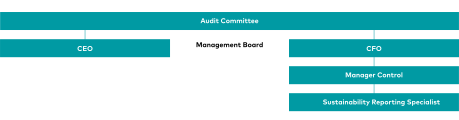
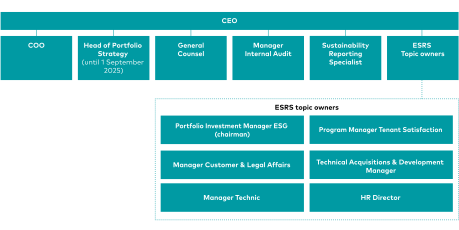
See the following figures for a schematic view of how the ESG roles are structured in our organisation.
Charter CSRD implementation
Charter ESG Committee
Management Board
The Management Board has a 50%-50% female/male ratio and consists of Astrid Schlüter (CEO) and Frits Vervoort (CFO). Vesteda operates exclusively as a real estate investor in the Netherlands, where both executives have extensive experience. Additionally, they possess management expertise that aligns with their roles and the sector in which Vesteda is active.
The Management Board is responsible for defining the Fund’s overall strategy, which is set out in the business plan, as approved by the Participants. In respect of sustainability matters, the Management Board ensures that the strategy is converted into defined policies, targets and KPIs. As such, the Management Board is responsible for the oversight of sustainability related impacts, risks and opportunities. In particular, the CFO is responsible for the implementation of the CSRD, taking into account the scope as referred to in the section General basis of preparation.
For the day-to-day execution of the Fund’s business plan, the Management Board is supported by the Management Team. This includes the implementation of defined policies, targets and KPIs. A more detailed description of the Management Board’s duties, responsibilities and expertise can be found in the section Members of the Management Board.
In the year under review, the Management Board reported on a range of subjects, including the compliance with the CSRD requirements and the use of the sustainability budget. The material topics identified in the Double Materiality Assessment (DMA) are also discussed and approved by the Management Board on an annual basis. Refer to the section Materiality analysis and results according to the concept of double materiality for the material topics we have identified.
Descriptions of our corporate governance related to the legal structure can be found in the General Information section in the Governance & Risk Management in this annual report.
ESG Committee
With respect to sustainability matters, the Management Board is also supported by the ESG Committee, which is chaired by the Portfolio Investment Manager ESG. Since 2025, the ESG Committee comprises the CEO, COO, Portfolio Investment Manager ESG, Program Manager Tenant Satisfaction, Head of Portfolio Strategy (until 1 September 2025), General Counsel, Manager Internal Audit, Manager Customer & Legal Affairs, Technical Acquisitions & Development Manager, Manager Technic, Director Human Resources (HR) and the Sustainability Reporting Specialist. The members have been selected based on their knowledge of specific topics related to sustainability matters, such as, but not limited to, climate change, legislation, reporting and the supply chain. Compared to prior year, the composition of the ESG Committee was expanded with additional team members, in line with the designated ESRS topic owners for the material topics. This reflects the relevance of the CSRD implementation process within the Committee, underscoring the importance of engaging all topic owners.
The ESG Committee plays a non-executive role, focusing solely on internal monitoring and signalling. The ESG Committee oversees the development and implementation of Vesteda’s ESG strategy, ensuring clear governance and accountability across the organisation. It monitors ESG-related risks, assesses progress on key objectives and verifies the integrity and compliance of ESG reporting and data. Additionally, the committee advises the Management Team on regulatory developments and provides strategic input on emerging legislation and its implications for Vesteda. The ESG Committee meets quarterly to monitor the progress on these topics and to provide guidance where needed.
ESRS topic owners
To ensure high-quality and accountable sustainability reporting in line with CSRD, Vesteda has appointed dedicated topic owners for each European Sustainability Reporting Standard (ESRS). These internal experts are responsible for drafting the relevant sections of the sustainability report, formulating objectives in their area of expertise, and implementing targeted actions. In addition, topic owners play a key role in the update of the Double Materiality Assessment (DMA) as performed in 2025. Multiple internal alignment sessions were held with the respective topic owners, during which they were invited to provide substantive input for the update of the DMA. In these sessions, topic owners applied a critical and professional perspective, drawing on their subject-matter expertise to review and challenge the applied weighting factors, the underlying rationale, and the overall assessment of material versus non-material topics and sub-topics within their respective areas of responsibility. This process contributed to a well-founded, balanced and robust outcome of the DMA.
Sustainability Reporting Specialist
In Q1 2025, Vesteda appointed a dedicated Sustainability Reporting Specialist to oversee the implementation of the CSRD reporting requirements. This specialist connects directly with the ESRS topic owners and reports on a monthly basis to the CFO on the status of the implementation process, and addresses issues and attention points in this regard.
Audit Committee
The Audit Committee operates as a subcommittee of the Supervisory Committee and consists of two members of the Supervisory Committee who possess relevant knowledge and experience in financial reporting, internal audit, and risk management. The Management Board, the Internal Auditor, and the external auditor attend, to the extent possible, all meetings of the Audit Committee. The Company Secretary is also present to record the minutes of the meeting. The Audit Committee prepares decisions of the Supervisory Committee regarding the integrity and quality of Vesteda’s financial reporting and the effectiveness of its internal risk management and control systems. It oversees compliance with reporting standards, reviews internal and external audits, monitors the risk framework, and advises on the appointment of the external auditor.
Over the past year, the Sustainability Reporting Specialist attended two Audit Committee meetings to provide updates on topics including the double materiality assessment and the progress of the CSRD implementation process. These sessions ensured that the Audit Committee remained informed about sustainability-related reporting requirements and their integration into Vesteda’s governance and compliance framework.
GOV-3 - Integration of sustainability-related performance in incentive schemes
Vesteda’s policy regarding incentive schemes for members of the Management Team is partly linked to sustainability matters. Key sustainability targets are incorporated in Vesteda’s strategy, the performance evaluation and the incentive scheme. Energy performance is a fundamental factor in the remuneration of the Management Team. The integration of sustainability-related performance in incentive schemes ensures that the Management Team's compensation is aligned with the company's energy efficiency goals. Specifically, the assessment of the Management Team's performance includes targets related to the overall energy consumption. This approach not only incentivises the Management Team to prioritise energy efficiency but also aligns their financial rewards with the company's long-term sustainability objectives. By linking remuneration to energy performance, the company demonstrates its commitment to environmental responsibility and encourages the Management Team to actively contribute to achieving these goals.
The proportion of variable remuneration tied to sustainability-related targets and/or impacts constitutes 40% of the overall variable remuneration.
Decisions on the Management Board’s incentive scheme are made by the Supervisory Committee, when it comes to target setting, metrics and weight. The overall remuneration package of members of the Management Board (including the percentage of variable remuneration) is determined by the Fund’s participants.
Vesteda’s policy regarding incentive schemes for members of the Supervisory Committee does not link to sustainability matters. The members of the Supervisory Committee receive a pre-determined fee and do not receive any further incentive.
At Vesteda, the ESG Committee includes the CEO, COO and the HR Director: these Management Team members participate in an incentive programme that is tied to sustainability performance. The remaining committee members fall under Vesteda’s standard incentive framework, which does not provide specific incentives beyond their fixed salary.
Further details on Vesteda’s remuneration are highlighted in the Remuneration report.
Risk management and control systems
GOV-4 - Description of the due diligence on sustainability matters
The following table shows how and where the application of the main aspects and steps of the due diligence process are reflected in our Sustainability Statement:
Statement on due diligence
|
Core elements of due diligence |
Sections in the sustainability statement |
|
a) Embedding due diligence in governance, strategy and business model |
ESRS 2 GOV-2.26a, b; |
|
b) Engaging with affected stakeholders in all key steps of the due diligence |
ESRS 2 GOV-2.26a, b; |
|
c) Identifying and assessing adverse impacts |
ESRS 2 SBM-3.48; |
|
Core elements of due diligence |
Sections in the sustainability statement |
|
d) Taking actions to address those adverse impacts |
ESRS 2 MDR-A.68; |
|
e) Tracking the effectiveness of these efforts and communicating |
ESRS 2 MDR-M.75; |
GOV-5 - Risk management and internal controls over sustainability reporting
The ESG Committee focuses on monitoring and oversight of Vesteda’s sustainability strategy and the related impacts, risks and opportunities.
As for sustainability reporting, internal controls depend on the area of reporting, as various departments are responsible for providing input for our sustainability reporting. General information on Vesteda’s risk management and internal control system can be found in the section Risk Management.
Company, business model and stakeholder engagement
SBM-1 - Information on the market position and strategy of the company
Vesteda operates in the Netherlands as a real estate investor and provider of residential rental housing. Vesteda actively engages in the acquisition and management of and investment in residential properties. We also focus on embedding sustainability considerations in every aspect of our operations and engaging in continuous dialogue with our stakeholders to achieve positive impacts together. Our strategy is outlined in the Strategy section of this annual report. The key goals of Vesteda’s strategy include the company's commitment to sustainable property acquisition, efficient resource management, and stakeholder engagement. Vesteda identifies the main challenges ahead, such as adapting to regulatory changes and addressing environmental concerns. We conduct thorough evaluations of our residential properties and sustainable investment opportunities. We assess our investment decisions using Sustainability Impact Scores (SIS) to ensure they meet our high standards for environmental and social performance. Additionally, we apply the Green Finance Framework to our funding, which involves a comprehensive assessment of potential investments using our ESG (Environmental, Social, and Governance) criteria.
GRESB
The Global Real Estate Sustainability Benchmark (GRESB) provides a tool to compare the sustainability of real estate investment funds. The GRESB survey is designed to identify the sustainability performance of the real estate sector and is now a widely recognised and well-respected initiative. The environmental benchmark rates environmental management practices and their implementation, making it possible to compare different real estate investments on a national and international level. Vesteda believes that GRESB is helping to increase transparency with respect to the sustainability of real estate funds. To contribute to the continued evolution of the benchmark, Vesteda joined GRESB as a member in 2013.
In 2025, Vesteda was again awarded five out of five stars. The five-star rating is the highest attainable rating in the annual GRESB benchmark survey, representing the 20% best scoring participating funds worldwide. Vesteda is committed to remaining a top player in the field of sustainability at a national and international level.
UN PRI
The Principles for Responsible Investment (UNPRI or PRI) is a United Nations-supported international network of financial institutions. Its goal is to understand the implications of sustainability for investors and help signatories to facilitate the incorporation of these issues in their investment decision-making and ownership practices.
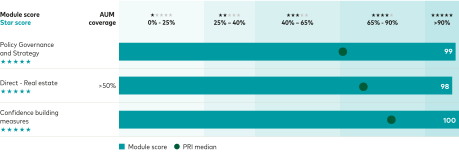
Vesteda achieved five-star ratings across all three applicable modules: 99% in Policy Governance and Strategy, 98% in Direct – Real Estate, and a perfect 100% in Confidence Building Measures. We are committed to maintaining these high standards and continuously improving where possible.
UN PRI summary score card
Sustainable Development Goals (SDGs)
Vesteda embraces the UN’s Sustainable Development Goals, which define global sustainable development priorities and aspirations for 2030. This common set of 17 goals and 169 sub-targets calls for worldwide action from governments, business and civil society to end poverty, ensure prosperity for all, and protect the planet. We consider the following SDGs the most relevant to our activities, based on what we do and our ambitions: Affordable and clean energy (7), Sustainable cities and communities (11), Responsible consumption and production (12) and Climate action (13). The following figure shows our SDG actions mapped along our value chain.
Our value chain and SDG actions
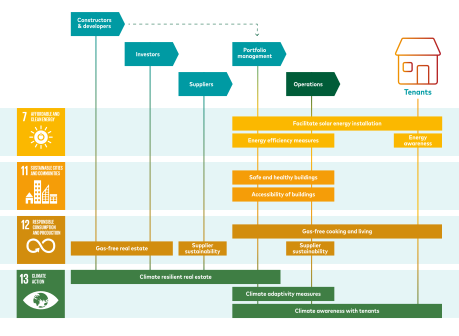
Our resource planning is designed to remain agile, ensuring that we can prioritise sustainability actions as needed within rigid allocation constraints. This approach supports our long-term ambition to create a resilient, future-proof real estate portfolio, while maintaining financial discipline and operational effectiveness. As such, our sustainability budget is not directly linked to the individual material impacts, risks and opportunities (IROs) identified in our double materiality assessment. Instead, we maintain a flexible approach that allows us to respond dynamically to emerging sustainability needs, regulatory developments, and stakeholder expectations. We continue to monitor our capital structure and financial conditions to safeguard our ability to fund sustainability initiatives. We assess any material changes in access to finance or cost of capital for their potential impact on our sustainability roadmap and disclose these in future reports.
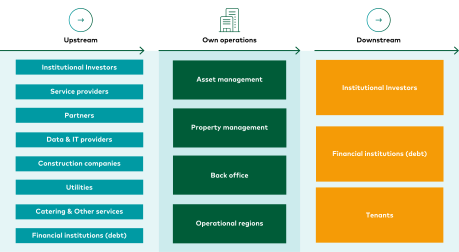
In the upstream segment, we collaborate closely with construction companies and developers who are committed to eco-friendly practices and provide investment assets. Moreover, we work with catering and other service providers, utilities, partners and waste disposal services ensuring minimal environmental impact. Finally, data & IT providers are part of our upstream value chain for efficient resource management, along with institutional investors committed to having an impact with their investments.
The inputs from our upstream segment are gathered through rigorous selection processes that emphasise sustainability and long-term value creation. Our approach includes embedding sustainability considerations in supplier selection and procurement processes, as well as engaging in continuous dialogue on how to have a positive impact together. The main inputs relating to our business are a skilled and inclusive workforce, reflecting the communities we serve. Additionally, in collaboration with our subcontractors we use construction materials like concrete, steel, timber, and asphalt, supported by machinery, tools, and buildings construction technologies. Financially, our capital is sourced from institutional investors and debt capital providers.
Within our own operations, we prioritise sustainability by working with operational regions fostering strong stakeholder relationships, back-office functions, asset management focusing on long-term value creation through sustainable investments, and property management ensuring daily operational efficiency that is aligned with our sustainability goals.
Downstream activities involve serving tenants by providing high-quality living spaces and engaging with institutional investors to deliver returns through sustainable property management. The following figure visualises our mapped value chain:
Value chain mapping
Our outputs include high-standard residential properties for tenants and sustainable investment opportunities for institutional investors. The outcomes of our efforts are reflected in the current and expected benefits for our stakeholders. For tenants, this means providing safe, comfortable, and sustainable living environments, while also reducing housing costs through energy-efficient homes. For investors and financial institutions, it translates to stable returns through rental income and property appreciation, combined with a clear focus on long-term value creation driven by responsible asset management. Other stakeholders, such as service providers and partners, benefit from long-term collaborations that prioritise sustainability and mutual growth.
While we continuously make changes to our real estate portfolio, we maintain our focus on the middle-income households that are our primary customer group. More details are outlined in the Strategy section of this annual report. Our employee headcount is provided in section S1-6 Characteristics of the undertaking’s employees.
SBM-2 - Stakeholder interest and engagement
Understanding the interests and views of our stakeholders is crucial for Vesteda to bring our purpose to life. Understanding the impact of our activities and business relationships on stakeholders in the value chain is part of this dialogue. Categories of stakeholders that are relevant include employees, participants, lenders/debt investors, partners/business partners and local authorities and advisors/real estate experts. The table on the next page gives an overview of the structural dialogue between Vesteda and its key stakeholders:

Dialogue with stakeholders
|
Stakeholders |
Dialogue |
Content dialogue |
Impact dialogue on policy Vesteda |
|||
|
Employees |
• Feedback forms |
• Vesteda Improves project, HPO |
• Identification of integral improvement programmes |
|||
|
Participants |
• General Meeting of Participants |
• Business Plan 2026-2030 |
• Continued attention for affordability of housing and total cost of living |
|||
|
Lenders/debt investors |
• Annual credit review meetings |
• Strategy |
• Transparent reporting standards; improved reporting |
|||
|
Partners/business partners and local authorities |
• Through membership and meetings of IVBN, INREV, ULI, NEPROM, DGBC and GBC-Z. |
• Increase homes that are attainable for middle income households / affordable housing |
• Sector effort to realise more affordable housing in urban environments |
|||
|
Advisors/real estate experts |
• Workshop on sustainability |
• Sustainability, re-development of existing properties |
• Research into sustainability and continued embedding in policy |
Vesteda engages with stakeholders mainly through one-on-one conversations between a member of our Management Board and the stakeholder, often supported by a colleague with specific knowledge of the topic, as shown in the table. Examples are meetings, such as a General Meeting of Participants or the Regular debt investor/lender meetings, and conferences, such as the Expo Real conference. These conversations also allow us to delve deeper into the material topics to verify that they align with our stakeholders’ views and concerns. In addition to verifying material topics, we challenge our stakeholders to tell us where Vesteda could improve its way of working, service offerings or way of communication. These topics are reflected in satisfaction surveys which are sent out to our participants and tenants. Furthermore, there are digital channels that offer opportunities for dialogue to stakeholders, such as Sharepoint and the Investorweb.
It is also important that we understand the interests, views, expectations and needs of a wider group of stakeholders beyond our value chain, such as civil servants, politicians and regulatory bodies. These stakeholders are not directly part of the primary value chain as defined by Vesteda, but they do have a direct influence on the regulatory environment in which we operate. A final group of stakeholders are NGOs, academics and opinion leaders who, while not being part of our value chain or regulatory landscape, shape the societal debate on (sustainability) topics material to Vesteda and have opinions about us. Via an external stakeholder survey, we mapped the views of our external stakeholders on the DMA sustainability topics and on our salient topics.
Materiality analysis and results according to the concept of double materiality
IRO-1 - Description of the processes to identify and assess material impacts, risks and opportunities
In this Sustainability Statement, we provide the materiality results of our ESG (sub-)topics, as set out in the ESRS. Topic materiality is driven by impact materiality and/or financial materiality. Under the impact materiality direction, impacts can be classified as either negative or positive. For financial materiality, a (sub-)topic can be considered material either as a risk or an opportunity.
Vesteda employs a comprehensive seven-step methodology for its Double Materiality Assessment (DMA), including internal and external stakeholder engagement throughout the process. This assessment is conducted with full consideration of Vesteda's entire value chain. A list of potentially relevant sustainability matters is created based on stakeholder insights, prior assessments, and sector analyses. The next step involves defining the impacts, risks, and opportunities (IROs) associated with these sustainability matters and identifying whether they present material issues that require disclosure. These IROs are scored and assessed with attention to financial implications and the severity of potential impacts. The negative impacts are scored by modelling the scale, scope and irremediability, in addition to likelihood, whereas positive impacts are scored by modelling only the scale and scope in addition to likelihood. Opportunities and risks are scored by the size times the probability of occurrence. Vesteda employs a structured ranking system to categorise these impacts, risks, and opportunities by applying specific thresholds to distinguish between material and non-material issues. The threshold for negative impacts is set more stringently than for positive impacts, prioritising the identification and management of negative impacts. This process is further refined through internal and external expert consultations and validated with external stakeholders, ensuring a comprehensive understanding of the most material issues.
This sustainability report includes relevant information on the material impacts, risks and opportunities identified provided that the data and information are available and meet the required quality standards. The Sustainability Statement not only highlights Vesteda’s commitment to transparency with respect to informing our stakeholder on our sustainability performance, but also serves as a foundation for promoting a responsible and resilient business approach. Vesteda is committed to transparency, both in terms of the knowledge available and in areas where information may be lacking and strives to maintain openness in its reporting. We refer to the Content Index for all disclosure requirements complied with following the results of our DMA process.
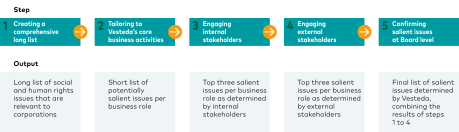
In parallel, Vesteda performed a salience assessment per business role in line with the United Nations Guiding Principles on Business and Human Rights (UNGPs). We conducted this assessment to identify the most relevant actual or potential negative human rights impacts that the company causes, contributes to, or is linked to. Please see a high-level description of the process used to determine salient issues for Vesteda on the following page.
Process to determine salient issues
Integration into Vesteda’s strategy and business model
The previous section shows that we conducted an extensive assessment, which was reported in our FY24 annual report. In the course of 2025, we subsequently reviewed and updated our DMA outcome. The DMA we performed forms the basis of our sustainability reporting. All identified impacts, risks and opportunities are reported in line with ESRS disclosure requirements. These material IROs form an input for Vesteda’s strategy and decision-making process. Vesteda's material impacts have both positive and negative effects on people and the environment. For example, energy-efficient upgrades reduce carbon emissions and improve tenant comfort, while regulatory compliance ensures the safety and well-being of tenants. These impacts are directly connected to Vesteda's strategy and business model, both of which prioritise sustainability and tenant satisfaction. The expected time horizons for these impacts vary, with some effects being immediate and others unfolding over the medium to long term. The current financial effects of Vesteda's material risks and opportunities on its financial position, performance, and cash flows are integrated into its existing business practices. These effects are considered when setting investment targets and establishing tolerance limits to manage potential profit and loss impacts.
The result of our double materiality assessment
Environment
Climate change
The (potential) negative impacts on people and the environment arising from Vesteda’s activities relate to both direct and indirect greenhouse gas (GHG) emissions and broader climate‑related risks. This encompasses the direct emissions from Vesteda’s own operations (scope 1), the indirect emissions from the real estate portfolio (scope 2), as well as the emissions associated with Vesteda’s value chain, including business travel, employee commuting and the procurement of goods and services (scope 3). In addition, Vesteda is exposed to transitional and physical climate risks that may affect its operations and value chain, including its real estate portfolio.
Social
Own workforce
The ESRS defines the own workforce as all employees and non-employees who are either people with contracts with the undertaking to supply labour (‘self-employed people’) or people provided by undertakings primarily engaged in ‘employment activities’. As an employer we can impact our own workforce, both negatively and positively. And from the financial impact perspective, our own workforce goes hand in hand with risks and opportunities for our company.
Workers in the value chain
Workers in the value chain are those who are not directly employed by the company but are part of the broader supply chain. These workers might be employed by suppliers, contractors, or other third parties that provide goods or services to the company. The focus of this disclosure includes ensuring fair labour practices, safe working conditions, and adherence to human rights standards across the value chain. Vesteda impacts these workers, both positively and negatively.
Affected communities
Affected communities are those living near Vesteda’s operations, that are impacted by the company’s activities. This includes addressing environmental, social and economic concerns. Vesteda impacts these communities and, the other way around, is impacted by these communities.
Consumers and end-users
Consumers and end-users are individuals who purchase or use Vesteda’s products and services, i.e. Vesteda’s tenants. Vesteda impacts their tenants through product safety, quality and customer satisfaction. Conversely, consumer feedback and behaviour impact Vesteda’s operations and reputation.
Governance
Business conduct
Vesteda impacts business conduct through its policies, practices, and corporate culture. This topic refers to the ethical and responsible behaviour of Vesteda in its operations. Ethical business conduct could enhance Vesteda’s reputation and stakeholder trust.
The DMA process was conducted in a similar way to the FY24 process, incorporating newly available data. The outcomes of our DMA update represent our current understanding of material topics based on existing data and stakeholder engagement. As our business environment, stakeholder expectations, and regulatory landscapes continue to evolve, it is important to note that these results may be subject to change. We remain committed to revisiting our assessments regularly, incorporating new insights and feedback to ensure that our focus remains aligned with the most pertinent sustainability issues. This iterative approach helps us adapt to emerging challenges and opportunities, thus maintaining the relevance and effectiveness of our sustainability strategies.
Reference is made to the following table for detailed information on the ESG-related impacts, risks and opportunities we have identified and assessed as material based on the DMA we performed. The table indicates whether the impacts, risks and opportunities occur within our own operations or across the value chain. For impact materiality, we have specified whether an impact is positive or negative and if this is an actual or potential impact. For financial materiality, we have identified the material risks and opportunities. We provide brief descriptions of the impacts, risks or opportunities, including the relevant time horizons.
DMA results FY25 Legend
|
Type of materiality |
Value chain postion |
Time horizon |
|||
|
Positive |

|
Upstream |

|
Short term |

|
|
Negative |

|
Own operations |

|
Medium Term |

|
|
Opportunity |

|
Downstream |

|
Long Term |

|
|
Risk |

|
DMA results FY25 Overview
|
Topic |
Description |
Type of materiality |
Value chain |
Time horizon |
|---|---|---|---|---|
|
ESRS E1 Climate change |
||||
|
Climate mitigation |
Negative impact on global warming due to greenhouse gas emissions from Vesteda’s own operations (Scope 1, 2 and 3 (Category 3.5, 3.6, 3.7 and 3.11)) |
|

|
|
|
Climate mitigation |
Negative impact on global warming due to greenhouse gas emissions from Vesteda’s portfolio (Category 3.1, 3.2, and 3.13) |
|

|
|
|
Climate adaptation |
Opportunity for Vesteda to differentiate itself from competitors through a strong and consistent sustainability policy, supported by robust GHG accounting and climate risk analyses |
|

|
|
|
Climate mitigation |
Opportunity for Vesteda to reduce tenant housing costs by renovating existing homes in its real estate portfolio |
|
|
|
|
Climate adaptation |
Risk of substantial damage to buildings in the portfolio due to extreme weather conditions, such as heat stress, flooding, drought, and heavy rainfall |
|
|
|
|
Climate mitigation |
Risk that Vesteda and/or its suppliers may face higher CapEx/OpEx due to sustainability efforts across the value chain and new climate-related regulations, such as CO₂ taxation |
|
|

|
|
Climate adaptation, mitigation, energy |
Risk that Vesteda may not find suitable real estate investment opportunities aligned with investors’ expected ROI, due to rising CO₂ taxes or other carbon-related costs, increasing construction costs |
|
|
|
|
ESRS S1 Own workforce |
||||
|
Working conditions |
Positive impact on employee well-being by ensuring job security, reasonable working hours, and a healthy work-life balance |
|
|
|
|
Working conditions |
Positive impact by offering employee flexibility, including remote work options and home office purchases |
|
|
|
|
Working conditions, equality |
Positive impact on employees through a strong internal speak-up process, including investigations into undesirable behaviour within the workforce |
|
|
|
|
Working conditions |
Opportunity to enhance Vesteda’s image through employees’ healthy work-life balance, and to increase productivity and effectiveness driven by employee satisfaction |
|
|
|
|
Equality |
Opportunity to improve employee productivity through appreciation and equal treatment within Vesteda |
|
|
|
|
Other work related rights |
Risk that information flows, systems, or tools may be insufficiently secured, potentially leading to loss or theft of employees’ personal data |
|
|
|
|
ESRS S2 Workers in the value chain |
||||
|
Working conditions |
Negative impact on workers employed by contractors and subcontractors due to Vesteda’s pricing demands, potentially resulting in inadequate compensation |
|
|
|
|
Working conditions |
Negative impact on the health of production workers and/or construction workers due to the choice of building materials |
|
|
|
|
Working conditions, equality |
Opportunity for Vesteda to attract and retain (sub)contractors more easily through positive experiences with their employees |
|
|
|
|
Other work related rights |
Reputational risk due to products purchased by Vesteda being linked to forced labour. This may also lead to rising costs as EU regulations increasingly restrict the import of such products |
|
|
|
|
ESRS S3 Affected communities |
||||
|
Community impact |
Negative impact on social inclusion due to renovated homes no longer qualifying as social housing |
|
|
|
|
Community impact |
Positive impact on local residents through renovation and extension of existing buildings, enhancing neighbourhood, liveability and improving the overall appearance of an area |
|
|
|
|
Community impact |
Opportunity to strengthen relationships with local residents and enhance Vesteda’s reputation |
|
|
|
|
Community impact |
Opportunity to create a pleasant living environment through tenant selection procedures, focus on optimal product-market fit, and implementation of sustainability and maintenance measures in residential complexes |
|
|
|
|
ESRS S4 Consumers and end-users |
||||
|
Social inclusion |
Negative impact on end users due to a focus on specific types of housing aimed at higher socioeconomic classes, limiting access to housing for certain population groups or minorities |
|
|
|
|
Information related impacts |
Negative impact on customer well-being due to potential loss of personal information resulting from increased digital interaction |
|
|
|
|
Social inclusion |
Positive impact by providing housing for middle-income groups who currently face challenges in finding suitable accommodation |
|
|
|
|
Social inclusion |
Opportunity related to product/material quality control: when Vesteda homes are known for their high quality, this can have a positive impact on market position, customer retention, and future business opportunities |
|
|
|
|
Social inclusion |
Reputational risk if it becomes known that Vesteda (indirectly) excludes certain population groups from access to housing developed by Vesteda |
|
|
|
|
Social inclusion |
Reputational opportunity through the provision of housing for middle-income groups |
|
|
|
|
Information related impacts, personal safety, social inclusion |
Risk of tenant default and legal proceedings in cases of disputes |
|
|
|
|
Information related impacts |
Risk that information flows, systems, or tools are insufficiently secured, potentially leading to loss or theft of personal data belonging to customers or other stakeholders |
|
|
|
|
ESRS G1 Business conduct |
||||
|
Protection of the whistle blower |
Positive impact on the sense of safety and the accessibility of reporting misconduct, resulting from a well-functioning whistleblower policy |
|
|
|
|
Corruption and bribery |
Risk of minor instances of non-compliance with laws and regulations due to an inadequate system of policies, frameworks, and oversight of employee and supplier conduct |
|
|
|
|
Corruption and bribery |
Reputational risk for Vesteda arising from incidents related to corruption and/or bribery, which may lead to negative media coverage, employee attrition and loss of customers |
|
|
|
The outcomes of the 2025 DMA update show limited changes compared to the initial DMA which was performed in reporting year 2024. The strategic direction and prioritisation of sustainability topics have remained largely consistent. One notable adjustment is the deliberate decision not to include ESRS E5 Resource use and Circular Economy as a material topic in 2025. In the previous reporting year, Vesteda identified E5 Resource use and Circular Economy as a material sustainability topic, based on the outcome of the then‑conducted Double Materiality Assessment (DMA). This classification reflected the expectations at that time regarding the fund’s future activities, particularly in relation to acquisitions, renovations, and the integration of circular construction principles in new developments. As part of the updated DMA performed for the current reporting year, Vesteda reassessed all potential impacts, risks, and opportunities in line with ESRS requirements. While circularity remains a relevant theme in the broader sustainability landscape of our business model, the performed reassessment concluded that ESRS E5 can no longer be considered a material topic for the current reporting period. The primary reason for this change is the very limited level of activity in both acquisitions and renovation projects during the year. Vesteda’s development and acquisition pipeline is currently minimal, resulting in negligible exposure to circular construction decisions or material‑use impacts. Further detail on these limited activities is provided in the Subsequent Events section of the Financial Statements. Given the absence of significant operational developments in which circularity considerations would play a substantive role, the ESRS E5 topic does not meet the materiality threshold for 2025. Vesteda will continue to monitor developments in the portfolio pipeline and market landscape, and ESRS E5 Resource use and Circular Economy will be reassessed in future DMAs should acquisition or renovation activity increase. See the figure Material topics in Vesteda’s value chain for the mapping of the resulting material topics in Vesteda’s value chain.
Content index
The following content index illustrates the locations where the lists of Disclosure Requirements can be found. Other data points listed in ESRS 2 Appendix B, which are not included in the below table, are considered either not material or not relevant.
Content index
|
No. |
Description |
Reference |
Explanation |
|---|---|---|---|
|
ESRS 2 – General disclosures |
|||
|
BP-1 |
General basis for preparation of the sustainability statement |
||
|
BP-2 |
Disclosures in relation to specific circumstances |
||
|
GOV-1 |
The role of the administrative, management and supervisory bodies |
This covers GOV-1 section 21 (d) and (e). |
|
|
GOV-2 |
Information provided to and sustainability matters addressed by the undertaking’s administrative, management and supervisory bodies |
||
|
GOV-3 |
Integration of sustainability-related performance in incentive schemes |
GOV-3 - Integration of sustainability-related performance in incentive schemes |
|
|
GOV-4 |
Statement on due diligence |
GOV-4 - Description of the due diligence on sustainability matters |
This covers GOV-4 section 30. |
|
GOV-5 |
Risk management and internal controls over sustainability reporting |
GOV-5 - Risk management and internal controls over sustainability reporting |
|
|
SBM-1 |
Strategy, business model and value chain |
SBM-1 - Information on the market position and strategy of the company |
|
|
SBM-1 section 40(d)i-iv |
Involvement in activities related to fossil fuel activities, chemical production, controversial weapons, cultivation and production of tobacco |
These disclosures are not applicable to Vesteda. |
|
|
SBM-2 |
Interests and views of stakeholders |
||
|
SBM-3 |
Material impacts, risks and opportunities and their interaction with strategy and business model |
Materiality analysis and results according to the concept of double materiality |
Vesteda omits the information prescribed by ESRS E1-9 for quantitative disclosures, for the first three years of preparation. Vesteda does provide qualitative disclosures of physical climate risks and climate transition risks. |
|
IRO-1 |
Description of the processes to identify and assess material impacts, risks and opportunities |
||
|
IRO-2 |
Disclosure requirements in ESRS covered by the undertaking’s sustainability statement |
||
|
MDR-P |
Policies adopted to manage material sustainability matters |
The minimum disclosure requirements have been fully included in the Sustainability Report and are thereby fully covered. |
|
|
MDR-A |
Actions and resources in relation to material sustainability matters |
The minimum disclosure requirements have been fully included in the Sustainability Report and are thereby fully covered. |
|
|
MDR-M |
Metrics in relation to material sustainability matters |
The minimum disclosure requirements have been fully included in the Sustainability Report and are thereby fully covered. |
|
|
MDR-T |
Tracking effectiveness of policies and actions through targets |
The minimum disclosure requirements have been fully included in the Sustainability Report and are thereby fully covered. |
|
|
ESRS E1 – Climate change |
|||
|
GOV-3 |
Integration of sustainability-related performance in incentive schemes |
GOV-3 Integration of sustainability-related performance in incentive schemes |
|
|
E1-1 |
Transition plan for climate change mitigation |
This covers E1-1 section 14. |
|
|
E1-1 section 16 (g) |
Undertakings excluded from Paris-aligned benchmarks |
These disclosures are not applicable to Vesteda. |
|
|
SBM-3 |
Material impacts, risks and opportunities and their interaction with strategy and business model |
||
|
IRO-1 |
Description of the processes to identify and assess material climate-related impacts, risks and opportunities |
||
|
E1-2 |
Policies related to climate change mitigation and adaptation |
E1-2 - Policies related to climate change mitigation and adaptation |
|
|
E1-3 |
Actions and resources in relation to climate change policies |
E1-3 - Actions and resources in relation to climate change policies |
|
|
E1-4 |
Targets related to climate change mitigation and adaptation |
E1-4 – Targets related to climate change mitigation and adaptation |
Vesteda has chosen to not report a climate target but an entity-specific energy intensity target on its real estate portfolio which mostly covers scope 3, but also a small amount of scope 1 and 2 (combined target). |
|
E1-5 |
Energy consumption and mix |
This covers E1-5 section 37, 38 and 40 to 43. |
|
|
E1-6 |
Gross Scopes 1, 2, 3 and Total GHG emissions |
Category 3.1 Purchased goods and 3.2 Capital goods are currently excluded from the inventory due to the lack of actual data. Vesteda has prioritised gathering direct emissions data from our suppliers over relying on spend-based estimations. This data collection process is ongoing, and we anticipate being able to report detailed supplier-level emissions starting in FY2026. |
|
|
E1-7 |
GHG removals and GHG mitigation projects financed through carbon credits |
E1-7 – GHG removals and GHG mitigation projects financed through carbon credits |
Not material. Vesteda does not make use of financing through carbon credits. |
|
E1-8 |
Internal carbon pricing |
Not material. Vesteda does not make use of carbon pricing. |
|
|
E1-9 |
Anticipated financial effects from material physical and transition risks and potential climate-related opportunities |
Vesteda omits the information prescribed by ESRS E1-9 for quantitative disclosures, for the first three years of preparation. Vesteda does provide qualitative disclosures of physical climate risks and climate transition risks. |
|
|
ESRS E2 – Pollution |
|||
|
E2 |
All data requirements |
NA |
Not material. |
|
ESRS E3 – Water and marine resources |
|||
|
E3 |
All data requirements |
NA |
Not material. |
|
ESRS E4 – Biodiversity and ecosystems |
|||
|
E4 |
All data requirements |
NA |
Not material. |
|
ESRS E5 – Resource use and circular economy |
|||
|
E5 |
All data requirements |
NA |
Not material. |
|
ESRS S1 – Own workforce |
|||
|
SBM-2 |
Interests and views of stakeholders |
||
|
SBM-3 |
Material impacts, risks and opportunities and their interaction with strategy and business model |
This covers SBM-3 S1 section 14(f) and (g). |
|
|
S1-1 |
Policies related to own workforce |
This covers S1-1 section 20, 21, 22 and 23. |
|
|
S1-2 |
Processes for engaging with own workforce and workers’ representatives about impacts |
||
|
S1-3 |
Processes to remediate negative impacts and channels for own workers to raise concerns |
S1-3 - Acting on material impacts and mitigating material risks |
This coves S1-3 section 32(c). |
|
S1-4 |
Taking action on material impacts on own workforce, and approaches to managing material risks and pursuing material opportunities related to own workforce, and effectiveness of those actions |
||
|
S1-5 |
Targets related to managing material negative impacts, advancing positive impacts, and managing material risks and opportunities |
||
|
S1-6 |
Characteristics of the undertaking’s employees |
||
|
S1-7 |
Characteristics of non-employee workers in the undertaking’s own workforce |
S1-7 Characteristics of non-employees in the undertaking’s own workforce |
|
|
S1-8 |
Collective bargaining coverage and social dialogue |
||
|
S1-9 |
Diversity metrics |
||
|
S1-10 |
Adequate wages |
||
|
S1-11 |
Social protection |
||
|
S1-12 |
Persons with disabilities |
||
|
S1-13 |
Training and skills development metrics |
||
|
S1-14 |
Health and safety metrics |
This covers S1-14 section 88 (b), (c) and (e). |
|
|
S1-15 |
Work-life balance metrics |
||
|
S1-16 |
Remuneration metrics (pay gap and total remuneration) |
S1-16 - Remuneration metrics (pay gap and total remuneration) |
This covers S1-16 section 97 (a) and (b). |
|
S1-17 |
Incidents, complaints and severe human rights impacts |
S1-17 - Incidents, complaints and severe human rights impacts |
This covers S1-17 section 103 (a) and 104 (a). |
|
ESRS S2 – Workers in the value chain |
|||
|
SBM-2 |
Interests and views of stakeholders |
||
|
SBM-3 |
Material impacts, risks and opportunities and their interaction with strategy and business model |
This covers SBM-3 S2 section 11 (b). |
|
|
S2-1 |
Policies related to value chain workers |
This covers S2-1 section 17, 18 and 19. |
|
|
S2-2 |
Processes for engaging with value chain workers about impacts |
||
|
S2-3 |
Processes to remediate negative impacts and channels for value chain workers to raise concerns |
S2-3 - Acting on material impacts and mitigating material risks |
|
|
S2-4 |
Taking action on material impacts on value chain workers, and approaches to managing material risks and pursuing material opportunities related to value chain workers, and effectiveness of those actions |
This covers S2-4 section 36. |
|
|
S2-5 |
Targets related to managing material negative impacts, advancing positive impacts, and managing material risks and opportunities |
Vesteda omits the specification of target setting for ESRS S2 for the first two years of preparation of the sustainability statement. |
|
|
ESRS S3 – Affected communities |
|||
|
SBM-2 |
Interests and views of stakeholders |
||
|
SBM-3 |
Material impacts, risks and opportunities and their interaction with strategy and business model |
||
|
S3-1 |
Policies related to affected communities |
This covers S3-1 section 16 and 17. |
|
|
S3-2 |
Processes for engaging with affected communities about impacts |
||
|
S3-3 |
Processes to remediate negative impacts and channels for affected communities to raise concerns |
S3-3 - Acting on material impacts and mitigating material risks |
|
|
S3-4 |
Taking action on material impacts on affected communities, and approaches to managing material risks and pursuing material opportunities related to affected communities, and effectiveness of those actions |
This covers S3-4 section 36. |
|
|
S3-5 |
Targets related to managing material negative impacts, advancing positive impacts, and managing material risks and opportunities |
Vesteda omits the specification of target setting for ESRS S3 for the first two years of preparation of the sustainability statement. |
|
|
ESRS S4 – Consumers- and end-users |
|||
|
SBM-2 |
Interests and views of stakeholders |
||
|
SBM-3 |
Material impacts, risks and opportunities and their interaction with strategy and business model |
||
|
S4-1 |
Policies related to consumers and end-users |
This covers S4-1 section 16 and 17. |
|
|
S4-2 |
Processes for engaging with consumers and end-users about impacts |
||
|
S4-3 |
Processes to remediate negative impacts and channels for consumers and end-users to raise concerns |
S4-3 - Acting on material impacts and mitigating material risks |
|
|
S4-4 |
Taking action on material impacts on consumers and end-users, and approaches to managing material risks and pursuing material opportunities related to consumers and end-users, and effectiveness of those actions |
This covers S4-4 section 35. |
|
|
S4-5 |
Targets related to managing material negative impacts, advancing positive impacts, and managing material risks and opportunities |
Vesteda omits the specification of target setting for ESRS S4 for the first two years of preparation of the sustainability statement. |
|
|
ESRS G1 – Business conduct |
|||
|
GOV-1 |
The role of the administrative, management and supervisory bodies |
GOV-1 - Role of the administrative, management and supervisory bodies |
|
|
IRO-1 |
Description of the processes to identify and assess material impacts, risks and opportunities |
||
|
G1-1 |
Business conduct policies and corporate culture |
This covers G1-1 section 10 (b) and (d). |
|
|
G1-2 |
Management of relationships with suppliers |
||
|
G1-3 |
Prevention and detection of corruption and bribery |
||
|
G1-4 |
Incidents of corruption or bribery |
This covers G1-4 section 24 (a) and (b). |
|
|
G1-5 |
Political influence and lobbying activities |
These disclosures are not applicable to Vesteda. Vesteda does not provide financial support from company funds or otherwise, nor support in kind to political parties, their elected representatives, or individuals seeking political office. |
|
|
G1-6 |
Payment practices |
Not material. |
|